About Radical Family Farms
Radical Family Farms, established in 2018 with its first growing season in 2019, is located on a 3-acre plot in Sebastopol, California, nestled in Sonoma County. The farm specializes in cultivating culturally significant crops for the Chinese, Taiwanese, Korean, Japanese, and Southeast Asian diaspora, alongside non-Asian crops commonly found at California farmers markets. Radical Family Farms sits in the Gold Ridge growing region of Sebastopol - the same fine sandy loam soils where Luther Burbank established his experimental farm in 1885 and developed over 800 varieties of fruits, vegetables, and grains. He called Sonoma County "the chosen spot of all this earth, as far as nature is concerned." The mild coastal climate, long growing season, and well-drained Gold Ridge soils that drew Burbank here are the same conditions that make this land productive for the specialty crops Radical Family Farms grows today.
We are at at the Sebastopol Farmers Market every Sunday, and also offer wholesale produce through FEED Sonoma, delivering twice weekly across the Bay Area.
Our farming practices prioritize sustainability and ecological health. We utilize agroecological, regenerative, no-spray, chemical-free, and low-till methods. We source non-GMO seeds, favor certified organic options whenever possible, and save certain seed varieties each season to promote adaptation to our unique farming system.
As part of our commitment to food accessibility, we accept SNAP/CalFresh EBT, WIC, and Senior Farmers Market Checks year-round at our Sebastopol Farmers Market booth.
CORE VALUES OF THE FARM: SUSTAINABILITY AND SERVICE

2019 by Paige Green

2022 by Paige Green
Leslie PAN WiseR 潘曉航, Owner and Farmer
Leslie Wiser was born in Chicago and grew up across the Midwest, spending her formative years in St. Paul, Cleveland, and Indianapolis. In her early 20s, she worked a season on a 10-acre organic farm in Palmer, Alaska, where her passion for regenerative agriculture began to flourish. As a first-generation, mixed-race woman of Chinese-Taiwanese, German, and Polish Jewish descent, Leslie often found her story and cultural heritage underrepresented in mainstream society and American agricultural spaces. This lack of representation has fueled her ongoing exploration of her multifaceted heritage through her work and personal pursuits.
When Leslie became a mother, she envisioned food as a bridge to connect her children to their Korean Chinese-Taiwanese roots. This vision inspired her to create Radical Family Farms, the realization of a 20-year dream to farm and a meaningful step in her lifelong journey of self-discovery.
Leslie’s core values include family, service, excellence, prosperity, diligence, and efficiency.
Her favorite vegetables to grow are celtuce, Chinese-headed mustards, bitter melon, winter melon, long beans, kohlrabi, and a variety of basils, with a particular love for holy basil varieties.
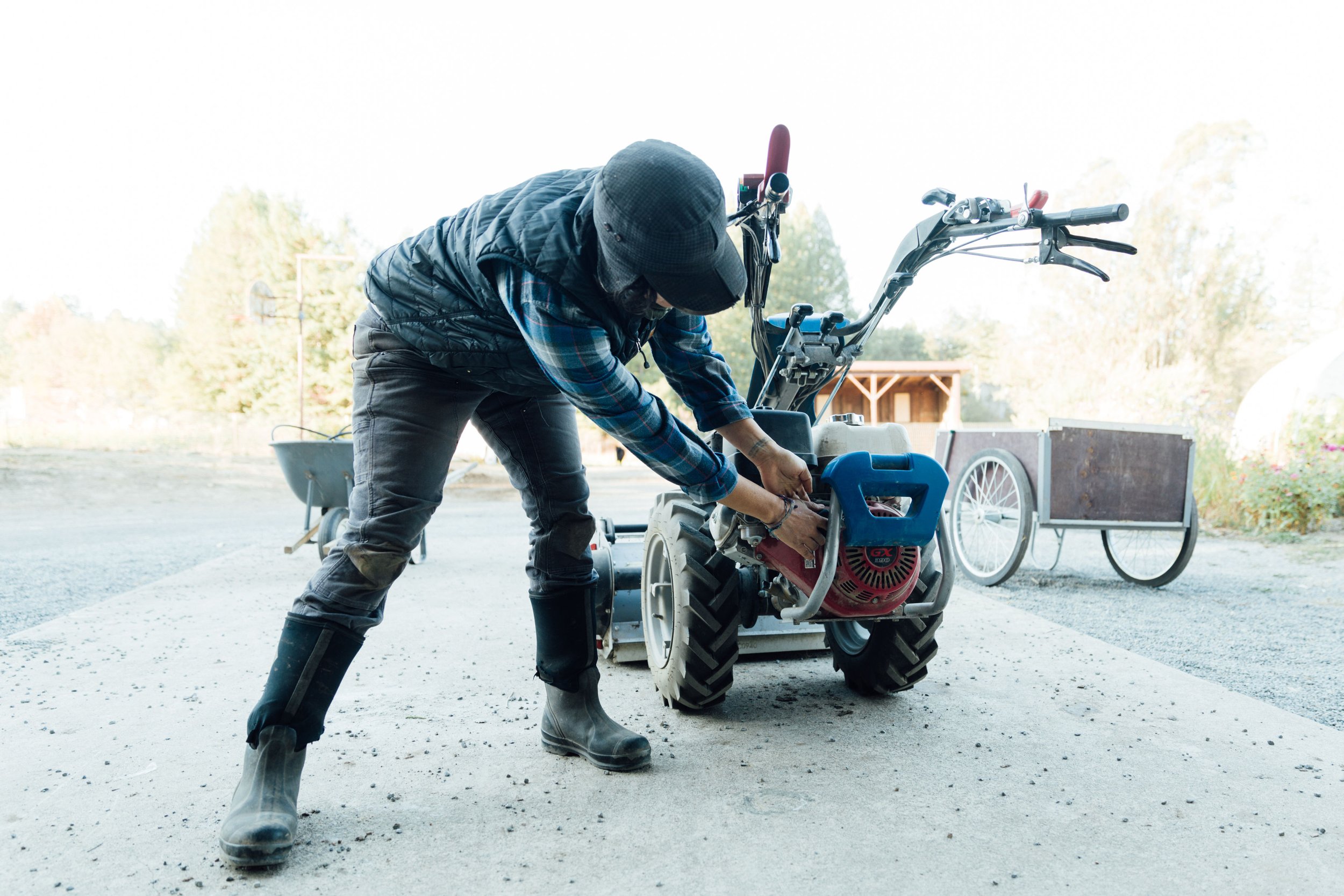
2020 Photo by Sarah Deragon
OUR STORY
Two families. Two wars. One FARM.
Leslie Wiser is the American-born child of immigrants - Chinese-Taiwanese on one side, German Polish-Jewish on the other. Her grandparents on both sides were displaced by the same century, and both families spent their American lives searching for ingredients that connected them to the food cultures they had left behind. Leslie grew up watching that search. Radical Family Farms is where it led.
The Chinese-TAIWANESE side
Leslie's Chinese grandparents met in Chongqing during the Sino-Japanese War. When that war ended and the civil war started, they fled to Taiwan.
The Chongqing flavors did not make the journey in their original form - but they found their way into something new. 眷村 - juāncūn - were the military dependents villages built across Taiwan after 1949, where soldiers and their families who fled the mainland were resettled together. Families from Sichuan, Hunan, Shanghai, Beijing, Shandong - all displaced, all crowded together - cooked for each other, traded techniques, and over decades created a uniquely hybrid cuisine filtered through exile, memory, and the ingredients available in Taiwan. The mala of Chongqing lived on in juāncūn kitchens - quieter, adapted, but present.
The German Polish-Jewish side
Leslie's Oma was a hidden child.
She was born in France; borders changed and she became stateless. She grew up in Poznań, Poland, a mixed German Catholic Polish Jewish girl. After her father's murder during Nazi occupation, she fled Poland at fifteen with her sister, taking a train to Schorndorf, Germany. There they lived with her German-Hungarian grandparents, who kept their mixed Jewish identity secret from the village. She survived by hiding in plain sight: speaking perfect German, tucking her curly hair under hats. Her grandparents never betrayed her.
When the war ended she met Leslie's German grandfather in Schorndorf. They came to America and settled in Indianapolis. Most of what she cooked wasn't German, Polish, or Jewish — it was Hungarian. Except the desserts. Those were German.
From 16 to 18, Leslie lived with them. Every evening around the kitchen table, her Oma cooked and told stories - of Poznań, of Schorndorf, of hiding, of coming to America and finding that the ingredients were never quite right. The bread. The pickles. And every autumn, the plum situation.
Her Oma made Pflaumenkuchen - her German grandfather's Bavarian plum tart. It required a specific plum: Italian prune plums, French varieties - the small dark oval ones that hold their shape in the heat and caramelize against the pastry just so. In Indianapolis she searched for them every season. Some years she found them. Some years she didn't. She made the tart anyway.
She passed a year and a half into Leslie's farming venture - proud of the farm, of the plum trees and the gooseberries and the currants Leslie had planted in her memory. She didn't live long enough to taste the fruit. When she passed, Leslie and her aunt and cousin pulled two-year-old frozen plums from her freezer and baked a Pflaumenkuchen together.
The plum trees at Radical Family Farms keep dying. Italian and French varieties - the right varieties - blight took them this year as other things took them before. So every autumn Leslie does what her Oma did in Indianapolis: she goes to other farmers, searches the markets and orchards, buys what she can find, and makes the tart.
THE FARMER
Leslie Wiser was born in Chicago and grew up across the Midwest - St. Paul, Cleveland, Indianapolis. She is the American-born child of immigrants - Chinese-Taiwanese on one side, German Polish-Jewish on the other. First generation. Mixed-Asian American, biracial.
Her parents were navigating their own American lives, and the food cultures of their families were present but incomplete - hard to maintain fully in the Midwest, where the ingredients weren't always available and assimilation pulled in its own direction. Leslie grew up with fragments of both traditions. Enough to know they were there. Not always enough to cook from them directly.
She founded Radical Family Farms in Sebastopol in 2018 - first growing season 2019 - on three acres in Sonoma County. She started with Chinese and Taiwanese heritage vegetables: celtuce, a tsai, bitter melon, winter melon, long beans, Chinese mustards, tong ho, gailan, holy basil. Crops of the diaspora. Ingredients that connect her children to a heritage she is still working out herself.
From there the shelf stable line developed. Er Jing Tiao chili peppers from seed passed on by another farmer. Bó Júhuā chrysanthemum from cuttings shared by a neighboring grower. Now RFF is one of the few farms in the United States cultivating commercial organic chrysanthemum varieties. Estate-grown Olio Nuovo cold pressed at a certified organic Sonoma mill on the day of harvest. Fermented Duo Jiao chili paste made from chilies grown on the farm, chasing the flavor of Lan Chi chili paste - beloved by a generation of Chinese American cooks, gone from shelves for over a decade.
The plum trees got planted. They keep dying. She goes to other farmers for the plums and makes the Pflaumenkuchen anyway.
The farm and its products are Leslie's personal exploration - a first generation American finding her way back to ingredients her family carried across two wars and two oceans.

2023 Photo by Lina Blanco-Ogden (@labandidalibre) for Sebastopol Farmers Market (@sebastopolfarmersmarket)